Overview
SimpleUDP provides Blueprint-callable UDP communication for Unreal Engine projects, combining multi-channel sending and receiving, asynchronous reception, address filtering, and runtime configuration in one plugin.
It targets projects that maintain UDP channels for different purposes and restrict source addresses at the receiver.
Background and goals
UDP can serve LAN messages, external device data, and other time-sensitive transmission scenarios. In practice, projects need to distinguish channels, configure addresses, and filter senders.
SimpleUDP wraps those communication management requirements in Blueprint interfaces.
Core capabilities
Multi-channel sending and receiving
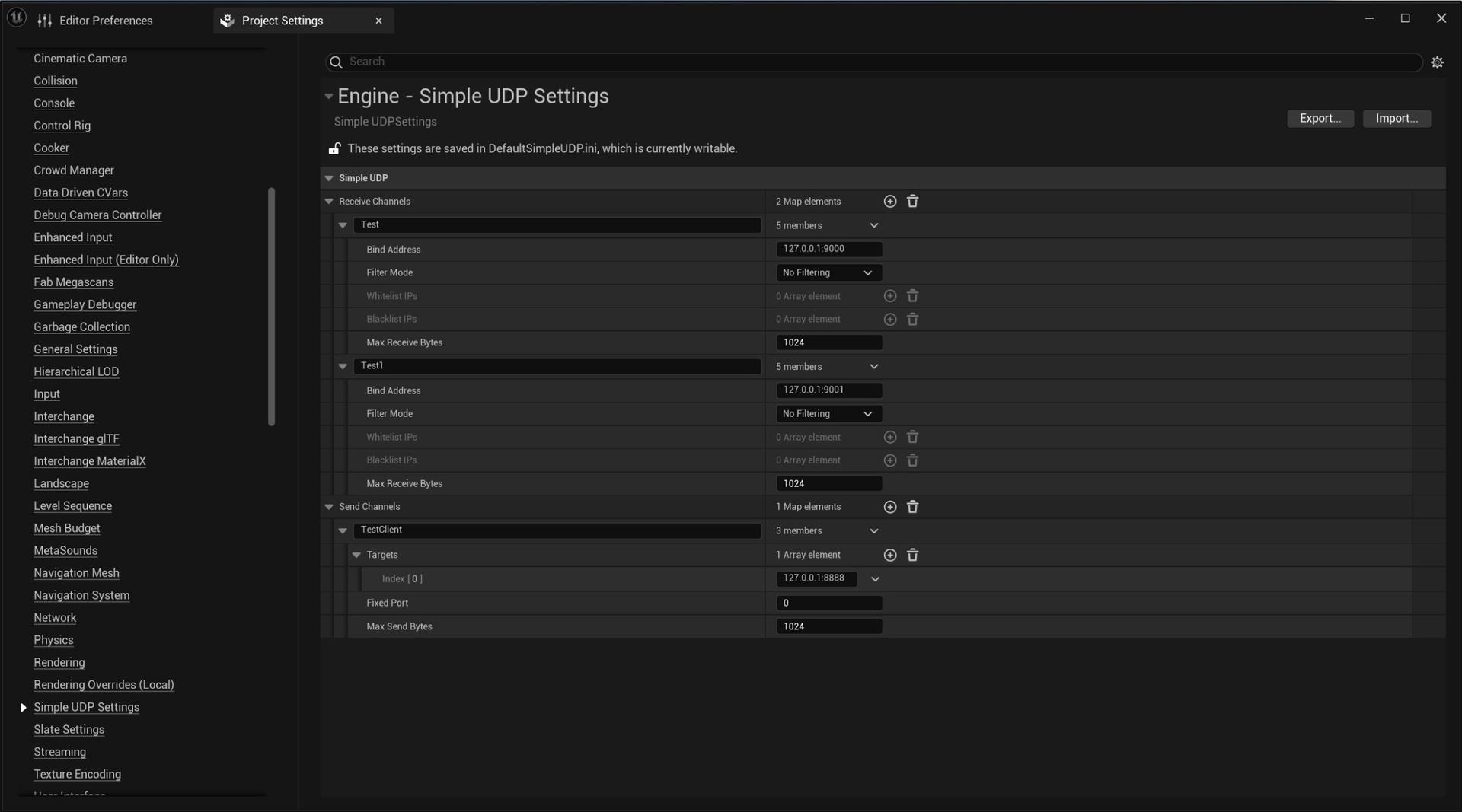
Several UDP channels can be configured and managed separately, with data sent and received per channel. Reception is asynchronous, keeping data waits out of the caller’s main Blueprint flow. Projects name and organize channels to match devices or business purposes.
Address filtering and broadcast
Receivers can filter sources through IP allowlists, blocklists, and CIDR ranges, with broadcast address support. Filtering limits network sources accepted for processing; it does not replace message identity validation or content checks.
Runtime configuration and Blueprint interfaces
Channel parameters can change at runtime, and Blueprints call the wrapped communication operations. Projects can integrate data into their own workflows, while both ends must still agree on byte formats, field meanings, and exception handling.
Use cases
It suits UE projects exchanging UDP data with LAN devices or external programs, requiring several independent ports or address-based filtering. Broadcast discovery and reception from multiple sources can also use channel and filter configuration to organize communication entry points.
Scope and limitations
Only IPv4 is supported; IPv6 and domain name resolution are not supported. UDP does not guarantee reliable delivery or arrival in send order. Projects implement message parsing, packet-loss handling, and business state maintenance. Verify channels, destination addresses, and filters against the actual network and protocol.
See the user guide for channel configuration, send and receive examples, and protocol limitations.